A pianist-composer in context
Adolf von Henselt belongs to the same Romantic generation as Chopin, Schumann, Liszt, Thalberg and Clara Wieck. Yet his music occupies a more elusive place beside them. He was not primarily a composer of symphonic forms, nor did he cultivate the public virtuoso identity that made Liszt a European phenomenon. His world was the piano itself: its singing line, its resonance, its ability to sustain colour, and the expressive tension created when a simple melody is surrounded by exceptionally rich textures.
That is why Henselt matters. His music offers a distinct kind of Romantic beauty: inward but not small, technically formidable but rarely empty, harmonically rich without becoming obscure. In his best pieces, the keyboard becomes a space of suspended lyricism. Melody, inner voices and figuration are held together in a single glowing sonority.
Henselt studied with Johann Nepomuk Hummel and Simon Sechter, a background that helps explain the unusual mixture in his music. From Hummel’s world came clarity, legato and a disciplined approach to touch. From the later Romantic world came a much broader sense of sound: wide-spanned chords, shimmering accompaniment figures, fuller textures and a stronger concern with colour. The result is neither post-Classical elegance nor Lisztian theatre, but something more private and concentrated.
His move to St Petersburg in 1838 was decisive. There he became court pianist and an influential figure in musical education. His importance in Russia was not simply institutional. Henselt represented a way of playing and writing for the piano that placed tone, legato and resonance at the centre of musical expression. Later Russian pianism would develop in many directions, but Henselt’s contribution to its early formation is part of what makes his music historically significant.
Even so, the music should not be valued only as a precursor to something else. Henselt is not merely a bridge between better-known names. The finest of these works have their own atmosphere: nocturnal, radiant, tender, sometimes impassioned, often touched by a kind of poetic inwardness that is immediately recognisable once heard.
Musical style
Henselt’s music is built around the idea of the piano as a singing instrument. His melodies often unfold in long, vocal phrases, carried over accompaniments that shimmer, ripple or thicken into a warm harmonic field. The melodic line is usually clear, but it is rarely isolated. Secondary voices answer it, support it, shadow it or briefly rise to the surface. This gives the music a distinctive sense of depth: the listener hears not only a tune, but a living texture around it.
The writing is often wide-spanned. Chords, arpeggios and accompanying figures frequently reach beyond ordinary hand positions, creating a fullness of sound that can feel almost orchestral. Henselt’s textures are not thick simply for the sake of weight. At their best they are carefully voiced, with resonance distributed across the keyboard so that the harmony seems to bloom around the melody.
His harmonic language is rich and colouristic rather than radical. Henselt does not usually destabilise tonality in the manner of Liszt, nor does he possess Chopin’s most elusive harmonic subtlety. His world is different: glowing modulations, expressive chromatic turns, broad intervals, suspensions and harmonies that are intensified by spacing and sonority. The beauty often lies in how a familiar harmonic language is made to sound unusually veiled, warm or luminous.
Virtuosity in Henselt is demanding, but it is rarely merely decorative. The difficulty lies in the combination of stretch, speed, legato, voicing and control. The pianist must keep melodic lines alive while negotiating wide positions and dense figuration. Inner voices must be heard without crowding the main line. Rapid passages must retain lightness. Chords must sound full without becoming heavy. This is virtuosity as refinement of touch, not simply as display.
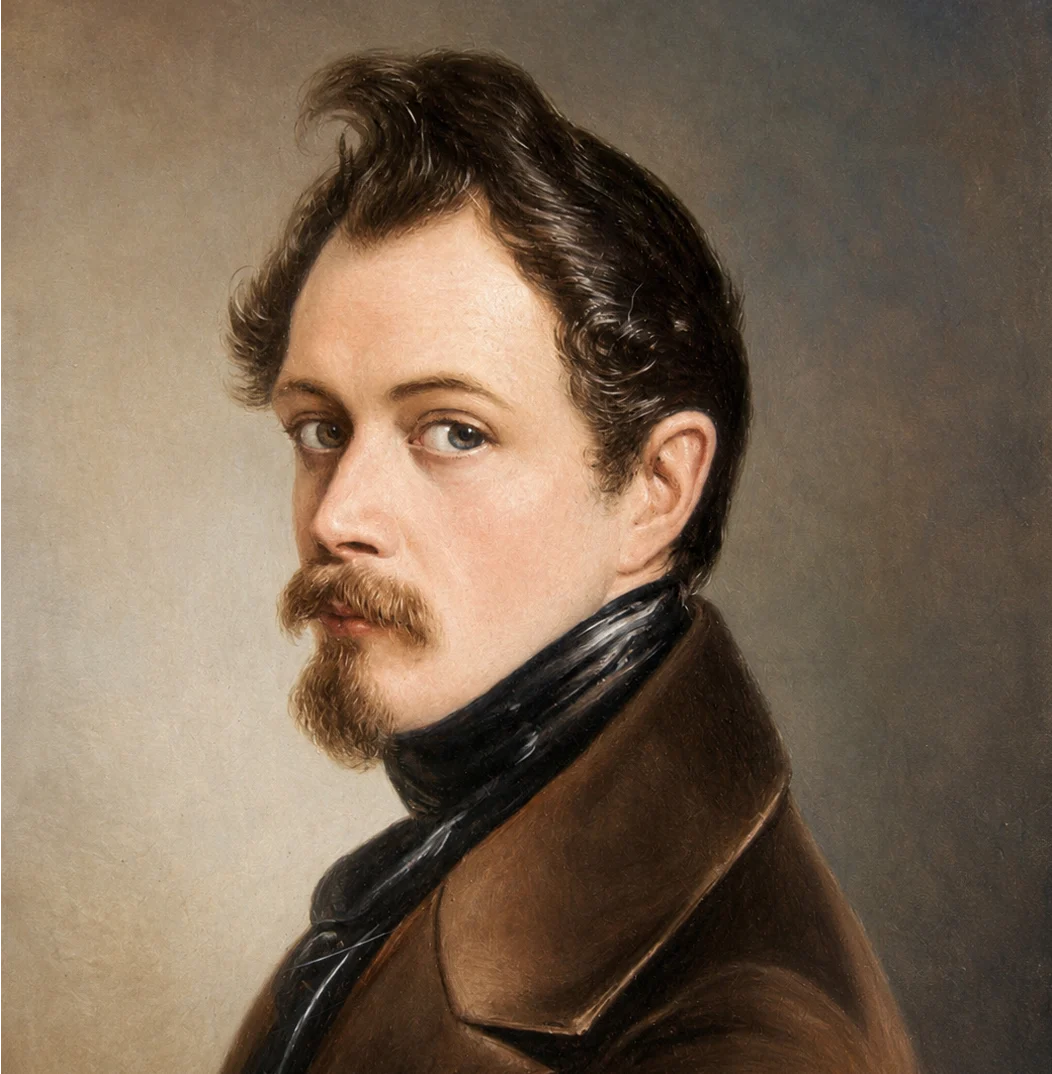
The smaller pieces — impromptus, waltzes, poetic character pieces — show Henselt at his most intimate. They often appear modest in scale, but they are full of pianistic detail. The larger works, such as the Variations de concert and the Ballade, place the same language on a more public stage. Here Henselt allows the music to expand into brilliance, but the essential character remains lyrical. Even when the writing becomes grand, it is the singing quality of the piano that holds the music together.
Place in the repertoire
Henselt’s music stands close to several familiar areas of nineteenth-century piano writing, but it does not fit neatly into any one of them. It touches the salon tradition, but it is far more serious in its pianistic demands and expressive concentration than that label often suggests. It belongs partly to the world of the virtuoso concert piece, yet its virtuosity is less theatrical than Liszt’s. It shares Chopin’s love of cantabile and poetic atmosphere, but its textures are wider, denser and more resonant. It has affinities with Schumann’s character pieces, but Henselt’s imagination is more directly centred on tone production and keyboard sonority.
The later Russian connection is especially important. In Henselt one already hears a concern with the deep, singing, richly layered piano sound that would become central to Russian pianism. The comparison with Rachmaninov should be made carefully, but it is musically useful. Henselt’s long melodic lines, wide-spanned textures and saturated sonorities point towards a later world in which the piano is treated as a broad, resonant and emotionally direct instrument.
For modern pianists, this makes Henselt valuable in a very practical sense. His music expands the Romantic repertoire without merely adding more of the same. It offers pieces that are poetic, technically absorbing and sonically distinctive. They ask for a mature ear, a flexible technique and a love of colour. In return they offer a kind of beauty that is immediate but not obvious, refined but not pale, deeply pianistic without being empty display.
Why the music disappeared
Henselt’s disappearance from the regular repertoire was not the result of a simple failure of taste. Several practical and historical factors worked together.
The first is the difficulty of the writing. Henselt’s music often requires wide stretches, sustained legato, strong finger independence and careful control of dense textures. These demands are not always outwardly spectacular, but they are extremely exacting. If the texture is not voiced clearly, the music can sound heavy. If the melodic line is not sustained, its poetry can disappear. Henselt needs a pianist who can combine strength, delicacy and tonal imagination.
The second factor is Henselt’s own career. Severe stage fright limited his public life as a performer. Unlike Liszt, he did not spend decades carrying his music across Europe through performance, charisma and personal advocacy. After settling in Russia, he became increasingly associated with teaching and administration. His influence continued, but his works did not circulate with the same force as those of composers whose music was constantly performed, published, revised and promoted.
The third factor is the size and shape of his output. Henselt wrote a relatively small body of music, much of it for solo piano. A composer with a limited catalogue is more easily pushed to the margins when recital programmes and conservatory curricula begin to narrow around a smaller canon.
Availability also matters. Music survives through good editions, repeated teaching, recordings, advocacy and performance. If scores are difficult to find, unattractive to read or unreliable in detail, performers are less likely to take them up. Henselt’s music, which depends so much on clarity of texture and practical playability, particularly suffers when the materials are poor.
None of this means that the music is marginal in quality. It means that the conditions required for its survival were fragile. Henselt’s works need pianists, teachers and publishers willing to treat them not as curiosities, but as living repertoire.
Why these editions
Felix Editions publishes Henselt because this music is too beautiful to remain peripheral. These works belong to the more luminous and poetic regions of Romantic piano music: full of singing lines, glowing harmonies, delicate secondary voices and textures that reward close study at the instrument.
Our editions are newly engraved and prepared from historical sources, with attention to clarity, spacing and practical use at the piano. That matters especially in Henselt. His music depends on voicing, resonance, hand distribution and the legibility of dense textures. A clean and reliable score is not simply a matter of presentation; it helps the pianist understand how the music breathes.
These editions are intended for pianists, teachers, students and collectors who are drawn to Romantic repertoire beyond the most familiar works. They present Henselt not as a historical footnote, but as a composer of exceptional poetic refinement whose music deserves to be played, studied and heard.